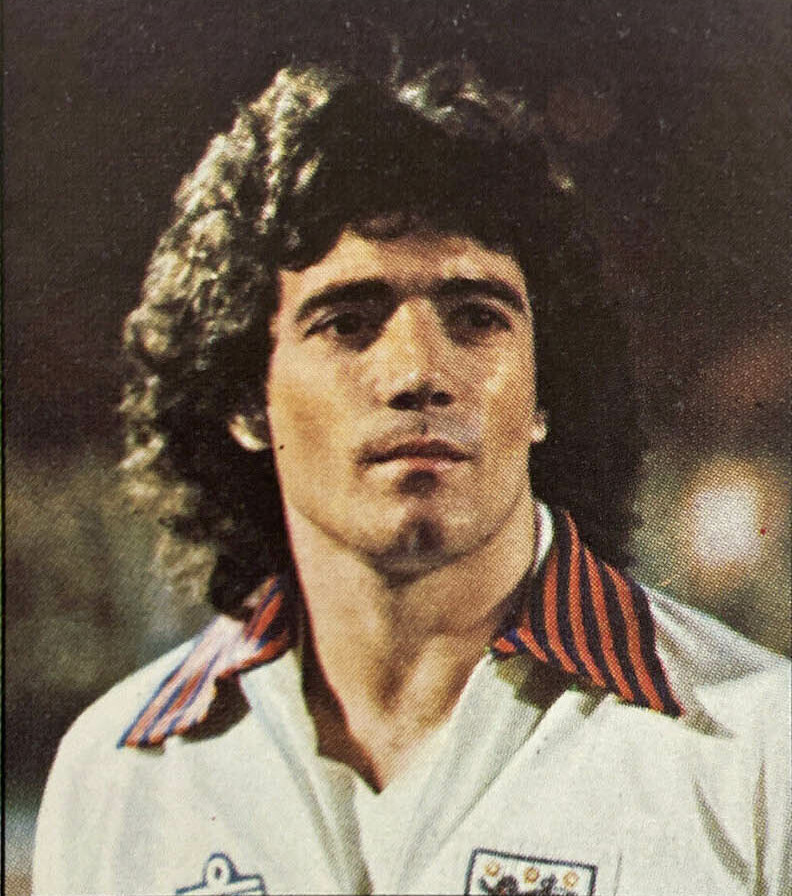
Anfield, on a July morning, is a quiet building. No fixture, no floodlights, the Kop a bank of empty red. The ground keeps its own hours in the close season, and the men who made it what it is come back to it only in the way the dead come back, which is in the telling.
Kevin Keegan has died, aged 75. The Guardian reported the news on Sunday, following a family statement that confirmed he had passed after living with cancer, the stage-four diagnosis he made public himself seven weeks ago. His family had first announced the illness in January. “A double Ballon d’Or winner, Kevin was a much loved husband, father and grandfather,” the statement read.T2 - The Guardian They asked for space, and for privacy, and for gratitude to be sent the way of the medical team who cared for him. Those are the plain facts. They do not begin to hold the man.
He was, before anything else, small. That is the thing the highlight reels forget. Keegan stood five foot eight in his boots and played every minute as though someone had told him he was too little to be there and he had decided, at seven years old in Doncaster, to spend a career proving it. He ran at people. He got up when they put him down. He scored the goals nobody expected the little forward to reach, and he did it with a curly-haired defiance that made him, for a decade, the most recognisable footballer in England.
Bill Shankly signed him from Scunthorpe United in 1971 for a fee that looked, within a year, like theft. Fourth Division to the First, a boy off the terraces of the lower leagues walking into the greatest side in the country. Shankly saw it in an afternoon. Keegan scored on his Liverpool debut and did not really stop for six seasons. He was the spark in a team that was already a machine, the movement that unlocked the patience, and he and John Toshack became the partnership by which all Anfield partnerships since have quietly been measured.
What he won there, he won in a rush. Two league titles. The FA Cup in 1974, the afternoon he scored twice at Wembley against Newcastle United, the club that would later claim the second half of his heart. Two UEFA Cups. And then, in his final act in a red shirt, the European Cup itself, Rome in 1977, Keegan running Berti Vogts into the Olympic Stadium turf until the great German defender conceded the penalty that settled it. He walked off the pitch a European champion and did not play for Liverpool again. He had already agreed to leave.
That was the other thing about him. He went. Most great players of that era stayed, dug in, took the testimonial and the statue. Keegan took himself to Hamburg, to the Bundesliga, to a country and a league that did not know quite what to do with an English forward who wanted the ball every second he was on the pitch. It should not have worked. It worked completely. He won the two European Footballer of the Year awards there, in 1978 and 1979, back to back, the only Englishman to manage it, playing in a foreign league at a time when English footballers who left were thought to be running away from something rather than towards it.
He came home eventually, to Southampton and then, in 1982, to Newcastle, and this is where the story stops being about medals and starts being about something harder to put a badge on. Newcastle in the early eighties were a Second Division club sliding towards nothing much. Keegan arrived and the city arrived with him. He got them promoted, played two seasons of pure carnival on the Tyne, and left the way he did everything, on his own terms, lowered out of St James’ Park by helicopter after his final match. It was theatrical. He knew it was theatrical. He also knew that a city which had believed in very little for a long time had, for two years, believed in something, and that the something had been him.
He gave them that twice. The second time was as a manager, and it is the version of Keegan that the younger reader will half-remember: the black-and-white cavalry of the mid-nineties, the Newcastle side that attacked as a matter of principle and defended as an afterthought, the team that led the Premier League by twelve points and then did not win it. Kevin Keegan’s Newcastle are the great English what-if, and he was too honest a man to hide from what happened to them. The night on live television when Alex Ferguson got under his skin and he lost his composure on camera has become a punch line for people who never watched him play. It should not be. It was the sound of a man who cared more than was good for him, in the one profession where caring that much will eventually cost you. He cared that much his whole life. It was the making of him and it was the price.
He managed England, too, sixty-three caps as a player behind him, the armband his for a spell in the late seventies. As a manager the national job did not suit him, and he knew it before anyone else did. He resigned in a toilet at the old Wembley, in October 2000, after a defeat to Germany in the last competitive match the stadium ever held, and he told the press honestly that he was not up to the tactical side of it at that level. There was no spin in him. There was never any spin in him. In a game that had already begun to teach its managers to say nothing at all, Keegan kept saying exactly what he felt, and the country loved him for it even when it laughed.
Tactically, he was not Bob Paisley and never pretended to be. He built teams the way he had played, forward, and he trusted that if his side scored one more than the other lot it did not matter how the goals came. It is a philosophy that wins you affection more reliably than it wins you leagues, and Keegan collected affection on a scale almost no English footballer has matched. The Ballons d’Or say he was among the finest of his age. The two cities that took him in, Liverpool and Newcastle, say something the trophies cannot, which is that he made ordinary people feel their club was capable of wonders. That is a rarer gift than a medal, and it does not retire.
There will be a minute’s applause at grounds up and down England when the season starts. There will be the number seven on the Kop and the number seven at St James’ Park and a generation of men in their sixties explaining to their grandchildren, badly, through something in the throat, what it was to watch him. He belonged to the terraces before he belonged to the record books. He came from them and he never once forgot the road.
I am Liverpool by birth, and I will not pretend the news landed on me the way it lands on a neutral. My grandfather saw him at Anfield in the years I only have on grainy film. He used to say Keegan ran as if the ground was on fire behind him. I never understood the phrase until I found the old footage, and then I understood it entirely. There is a kind of player who makes you believe the game is worth your whole heart, and once in a while, if the years are kind to you, you get to watch one.
Kevin Keegan was the boy who made English football believe. He believed harder than any of us, longer than was sensible, right to the end. Rest, now. The running is done.
