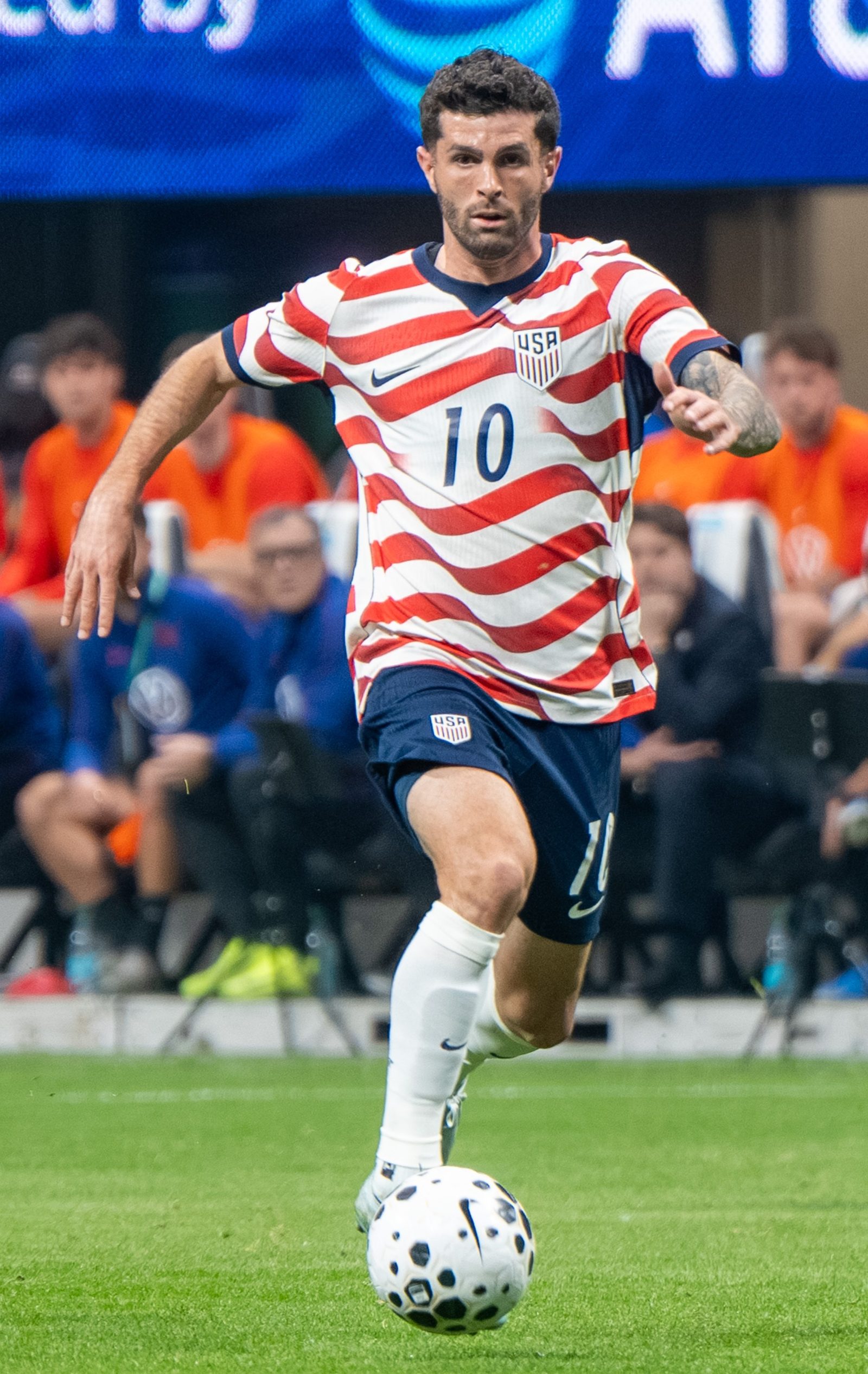
Inglewood, in the second week of June, wakes under the marine layer that Angelenos call the June gloom, a low grey ceiling that drifts in from the Pacific overnight and burns off by lunchtime, leaving the afternoons hot and white. SoFi Stadium sits beneath it like a beached liner, all swooping translucent roof and landscaped parkland, four miles from the airport and a half-hour crawl from anywhere else. This is where the United States open their home World Cup on Friday, and where, for the past several days, the most scrutinised American footballer of his generation has been answering questions about pressure with the even tone of a man discussing the weather.
The Athletic, in a tournament-eve piece on Christian Pulisic, reported a player of striking calm, measured in his approach to the biggest moment of his international career and openly welcoming the weight of a home World Cup that could send his stardom to another level entirely. The calm is the story. Not because it is unusual for a 27-year-old to have grown into himself, but because of what this particular 27-year-old has had to grow through to get here, and because of what the country around him is asking the next five weeks to mean.
American soccer has been promising itself a Pulisic for half a century. The promise has a structure, and the structure is always the same: a teenager emerges, usually abroad, and is immediately conscripted into a national project that has nothing to do with his actual job. Pulisic was given the conscription papers earlier than most. He was 17 when he debuted for Borussia Dortmund, a kid from Hershey, Pennsylvania, a town built by a chocolate company, playing in front of the Yellow Wall, and before he had completed a full Bundesliga season the American sports media had begun the coronation. The nickname that attached itself to him, Captain America, was never really about him. It was about the audience, a sporting culture that understands stardom as a national resource and wanted, finally, to mine one in this sport too.
What followed was every weather system a career can pass through. He was on the pitch in Couva in October 2017, a 19-year-old who scored the only American goal on the night Trinidad and Tobago beat the United States and knocked them out of the 2018 World Cup; the formative trauma of his footballing generation happened around him while he was the one player visibly trying to prevent it. He became the most expensive American player in history when Chelsea signed him, won the Champions League in west London, and spent four Premier League seasons in the peculiar limbo of a player too good to discard and too lightly used to settle, his fitness questioned, his minutes rationed, his American audience reading every team sheet as a referendum. In Qatar in 2022 he scored the goal against Iran that put the United States into the knockout rounds and injured himself doing it, colliding with the goalkeeper and finishing the night in hospital, which is about as literal as the metaphor of carrying a team ever gets.
Then came Milan, and the quietest, most productive stretch of his career. At AC Milan, Pulisic has been what he never quite managed to be at Stamford Bridge: a first-choice player whose week-to-week excellence is unremarkable, in the best sense. The Italian press treats him as a very good winger rather than a civilisational test case. It is probably not a coincidence that the player who arrives at this World Cup radiating composure is the one who spent the past three seasons being allowed to be ordinary.
The country he is carrying has its own relationship with this tournament, and it is more complicated than the broadcast graphics will allow. The United States has hosted a men’s World Cup before. In the summer of 1994 the final was played at the Rose Bowl in Pasadena, an hour up the freeway from SoFi, and I watched it as a child on a borrowed television in my grandmother’s house in Mombasa, Roberto Baggio’s penalty sailing over the bar in the Californian glare. That tournament was sold as the moment soccer would conquer America. It did not, not in the way the slogan meant. What it did instead was quieter and more durable: it seeded a professional league, a generation of players, and a footballing public that grew up alongside the sport rather than being converted to it.
Thirty-two years later, the 2026 edition arrives in a different country. Soccer in the United States is no longer a missionary project; it is simply present, fourth or fifth in the national sporting hierarchy depending on the city and the month, watched in Spanish as much as in English, played by suburban children in numbers that embarrass most of Europe. The question this World Cup poses is not whether America will fall in love with the game. It is whether the American team can give that existing, undramatic affection a focal point, and that question lands, as these questions always do, on the most famous player in the squad.
This is the weight The Athletic’s reporting describes Pulisic as welcoming, and the word welcoming is doing careful work. The pressure on him is real but it is not, strictly speaking, his. It is national. A home tournament in a 48-team format, spread across three countries and eleven American host cities, with a final at MetLife Stadium in New Jersey in mid-July, is an event the United States is staging for itself, a country examining its own relationship with the world’s game in public. Pulisic happens to be the face on the examination paper. The hype cycles he survived as a teenager were rehearsals for this, and the survivable thing about them, it turns out, was that none of them were ever really about Christian Pulisic the footballer. A player cannot control what a nation projects onto him. He can control his pressing angles, his first touch under contact, his sleep.
Mauricio Pochettino, the head coach, has the more contained version of the same problem. His job is not to redeem three decades of American soccer ambition; his job is to organise a back line and pick a midfield, and the distinction matters, because the history of host nations at World Cups is a history of teams either separating those two tasks or being crushed by their confusion. The mythology is a cultural object, interesting to people like me. The football is the work.
What struck me, reading the tournament-eve coverage from Los Angeles, is how thoroughly Pulisic seems to have internalised that separation. The measured persona is not an absence of feeling; it is a professional architecture, built over a decade in Dortmund, London and Milan, for keeping the national project at the correct distance from the day’s training session. American soccer spent 20 years asking when its great player would arrive. He arrived some time ago. What arrives on Friday at SoFi, under the burning-off gloom, is the country’s chance to watch him without needing him to be anything more than what he already is, and whether the United States can manage that restraint will say as much about its football culture as anything its team does with the ball.
