Mohamed Salah’s 2025/26 Premier League season is not merely excellent; it is, by the statistical and performative measures the game’s most credible evaluators use, the best individual campaign the competition has seen since the peak years of Thierry Henry. The Premier League’s own analysis unit, in its mid-season breakdown published this week, has compiled a body of data that places Salah at or near the top of every meaningful attacking metric: expected goals, expected assists, progressive carries, shot-creating actions, and the composite index the league uses to weight overall attacking contribution. He leads the division in goals. He leads it in assists. He leads it in the combined total. No player in the Premier League’s thirty-three-year history has, at the stage the season has now reached, matched the volume and the efficiency of what Salah has produced. The Player of the Season award, in any competition that values evidence, is his to lose.
The question that follows is not whether Salah deserves the domestic honour. The question is whether the domestic honour is sufficient, and whether the form he has shown this season has, by the logic of the game’s most prestigious individual prize, already settled the Ballon d’Or race. I believe it has, and I believe the case is stronger than the one that has been made for any Premier League-based candidate since Cristiano Ronaldo’s 2008 campaign at Old Trafford.
The Ballon d’Or, for all its imperfections, remains the award that measures a player’s standing across the full calendar year, and the 2026 race will be adjudged on performances from the autumn of 2025 through the summer of 2026. Salah’s Premier League numbers alone would place him in the conversation. What elevates him beyond it is the context. He is thirty-three years old. He is playing in what multiple reports have described as a season of significant squad transition at Liverpool, with Arne Slot’s departure confirmed and the club’s midfield and defensive structure in a state of visible reconstruction. The Premier League’s own breakdown notes that Salah’s output has been sustained across a period in which the team around him has been, by Liverpool’s own standards, inconsistent. He has not been carried by a dominant side. He has been the dominant element within a side that is still finding its shape.
This matters for the Ballon d’Or because the award’s voters, the international journalists who cast ballots for France Football, have historically weighted individual brilliance within a team context. Ronaldo won in 2008 because he scored forty-two goals and carried Manchester United to a Premier League and Champions League double. Messi won in 2021 because he dragged an Argentina side to the Copa America while maintaining his Barcelona numbers. The pattern is consistent: the Ballon d’Or goes to the player whose individual performance is both extraordinary and visibly indispensable. Salah’s 2025/26 season meets both criteria. Liverpool’s results in the matches he has missed or in which he has been below his standard have been markedly worse. The dependency is not a criticism; it is the evidence.
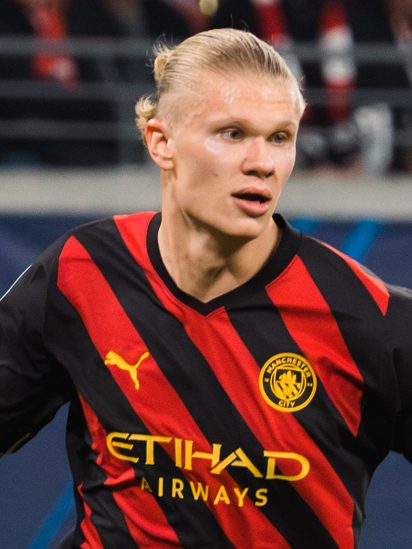
The competition, such as it is, comes from two directions. Kylian Mbappé’s move to Real Madrid has produced a season of adaptation rather than domination; his numbers are strong but not historic, and Real Madrid’s Champions League campaign has not yet reached the stage at which Mbappé’s legacy case would be cemented. Erling Haaland remains the most statistically prolific striker in European football, but Manchester City’s collective form has been uneven, and Haaland’s contribution, while enormous, has not carried the same narrative weight as Salah’s in a Liverpool side that is visibly being rebuilt around him. Vinicius Junior is the other name that will appear on ballots, and his case will rest on the Champions League; but the Champions League’s knockout stages have not yet produced the single-match performance that would override a full domestic season of Salah’s quality.
There is also the question of the Africa Cup of Nations, which concluded in early 2026. Salah’s Egypt did not win the tournament, and the AFCON result will be cited by those who argue that the Ballon d’Or should reward international-tournament success. This argument has surface merit and no historical foundation. The Ballon d’Or has, in its modern format, been awarded to players whose international campaigns were unremarkable. What it has not been awarded for is a season of sustained domestic excellence that is, by any reasonable measure, the best in the world. Salah’s is that season.
The Premier League’s status as the most-watched domestic competition in world football is a factor that works in Salah’s favour in ways that are difficult to quantify but impossible to ignore. His performances are seen by more people, in more markets, under more scrutiny than those of any player in any other domestic league. The Premier League’s global broadcast reach, which now extends to every inhabited continent and generates over four billion pounds in annual international rights revenue, means that Salah’s season is not merely excellent; it is excellently visible. The Ballon d’Or voters watch the Premier League. They watch it more than they watch La Liga, more than they watch Serie A, more than they watch the Bundesliga. Salah’s case is being made, every weekend, in front of the people who will decide the award.
I am aware that writing a Ballon d’Or column in February involves a degree of projection that opinion journalism does not always permit. The Champions League knockout stages may yet produce a performance that changes the calculus. Mbappé may yet have a April and May that overshadow everything that has come before. Haaland may yet score six goals in a quarter-final and render this column premature. But the question I am answering is not who will win the Ballon d’Or in December. The question is who is, on the evidence available, the frontrunner. And the frontrunner is Mohamed Salah, because no player in world football has done, this season, what he has done, where he has done it, with the consistency and the visibility with which he has done it.
The Premier League Player of the Season award should be a formality. The Ballon d’Or should be, on the evidence of this season alone, a formality as well. That it will not be, that the vote will be contested and the result uncertain, is a reflection not of any deficiency in Salah’s case but of the institutional reluctance of football’s awarding bodies to recognise sustained excellence in a player who is not, in the narrow demographic sense, a young European prospect. Salah is thirty-three. He is Egyptian. He has been the best player in the Premier League for the better part of seven years. The award should have come before. That it has not is the game’s failure, not his.
Mohamed Salah’s season is the best in the world. The Ballon d’Or, if it is to mean anything, must reflect that.
