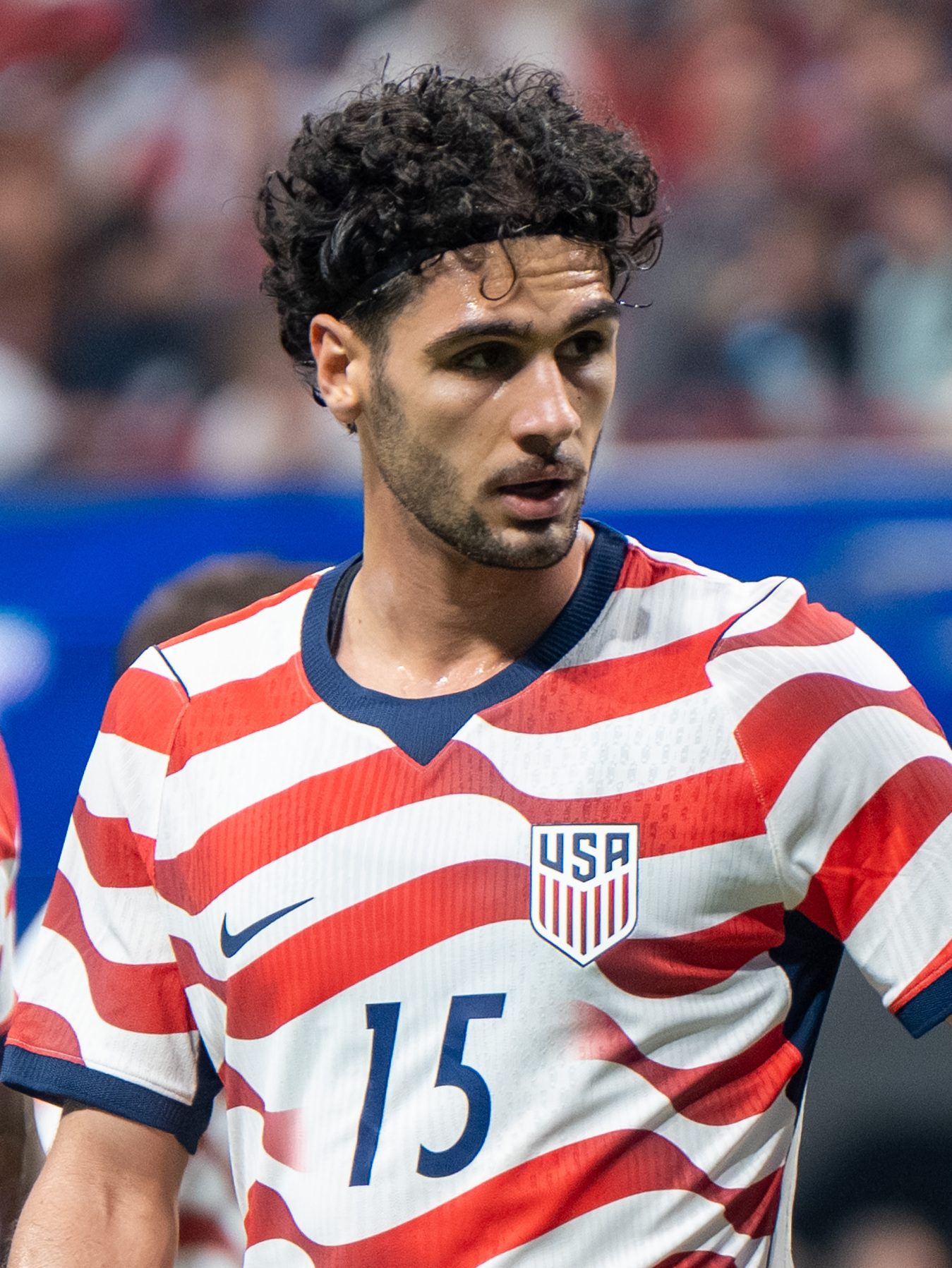
Madrid, on a Monday afternoon in mid-June, smells of hot stone and exhaust fumes. The Atlético Madrid training complex in Majadahonda, where the club announced that Johnny Cardoso would undergo surgery on his right ankle, sits behind a row of eucalyptus trees on the western edge of the capital. The surgery, to repair what the club described as damage sustained during the latter stages of the La Liga season, puts one of the United States men’s national team’s most important midfielders into a timeline that runs directly through the preparation period for a World Cup on American soil.
Cardoso, twenty-three, moved to Atlético from Real Betis in January for a fee reported at around thirty million euros. His first five months at the club were a kind of audition under Diego Simeone, whose midfield demands are among the most physically exacting in European football. The Brazilian-born, New Jersey-raised midfielder met those demands well enough that by March he was a regular starter, operating in the deeper of Simeone’s two central positions, the one that asks a player to cover the half-spaces and recover the ball before the back line is exposed. The ankle, which had been bothering him for weeks, was managed through strapping and painkillers until the end of the domestic campaign. The surgery, in June, was the reckoning.
The timeline Atlético offered was deliberately vague. The club said Cardoso would “begin his recovery process” following the procedure, a formulation that, in football medical parlance, means somewhere between three and five months before a return to full training, and longer before a player is match-fit at the intensity Simeone’s system requires. The World Cup kicks off on 11 June 2026 in Mexico City. The United States, as hosts, open the tournament that same evening at MetLife Stadium in East Rutherford, New Jersey, fourteen kilometres from where Cardoso grew up in the suburb of Long Branch. The geography is almost too neat; the medical reality is less accommodating.
The USMNT’s midfield, under Mauricio Pochettino, has been built around a specific idea of what Cardoso offers: the capacity to receive the ball under pressure in the first phase of possession and redistribute it into the channels where the wide forwards, more probably Timothy Weah and Christian Pulisic than any other combination, can operate. Weston McKennie provides the vertical running and the aerial presence. Yunus Musah, when fit, provides the ball-carrying through the middle third. Cardoso provides the quiet base, the metronome function that allows the more dynamic players to do their work. His absence, for any length of time, removes the connective tissue from Pochettino’s preferred structure.
The United States’ recent fixtures have reflected a team in transition between identities. The 2022 World Cup, under Gregg Berhalter, was built on pressing intensity and the athleticism of a young squad. Pochettino’s version, assembled over the past eighteen months, is more positional, more patient, more willing to hold the ball in the middle third and wait for the opening rather than forcing it through counter-pressing. Cardoso is the embodiment of that shift. He is the player who makes Pochettino’s system legible.
The surgery, then, is not only a medical event. It is a strategic one. The USMNT’s group-stage opponents have not yet been confirmed; the draw is scheduled for December. But the preparation schedule, which Pochettino has built around a series of friendlies in the autumn and winter, assumes a fully fit midfield. If Cardoso misses the September and October windows, Pochettino will need to find a replacement who can do what Cardoso does, which is not the same as finding a replacement who can play in Cardoso’s position.
The alternatives exist but they are different players. Luca de la Torre, now at Celta Vigo, can operate in the deeper role but lacks Cardoso’s physical presence. Tanner Tessmann, at Lyon, has the frame but not the positional discipline. The temptation, for Pochettino, will be to shift McKennie into a deeper role and bring in a more attacking midfielder behind him, which changes the entire shape of the team. Every solution creates a new problem. This is the arithmetic of tournament preparation when one of your best players is on a physiotherapist’s table in Madrid.
Cardoso’s trajectory is, in some ways, a story about the changing geography of American footballers in Europe. A decade ago, the USMNT’s best players were scattered across the middle tiers of the continent’s leagues: the Eredivisie, the Belgian Pro League, the Championship. Today, they occupy starting positions at Atlético Madrid, at Juventus, at AC Milan, at clubs where the margins are thinner and the physical demands are greater. The ankle surgery is the cost of that elevation. The players are better; the environments are more punishing; the injuries, when they come, arrive at moments with greater consequences.
The USMNT’s World Cup, on home soil, will be the most-watched sporting event in American football history. The country’s infrastructure has been built for it; the stadiums are ready; the television contracts are signed. What remains unknown is whether the team that takes the field in East Rutherford on that June evening will have its full complement of players, whether the ankle that was operated on in Madrid in June will have healed in time for the most important month in the programme’s history.
Cardoso, for his part, has said nothing publicly since the announcement. His social media accounts, which he uses sparingly, have been silent. The surgery will take place in the coming days. The recovery will begin. The clock, for the United States and for Pochettino, started ticking the moment the club released its statement.
